Flying Deer Nature Center is a wilderness school and empowerment program based in New Lebanon, a few hours north of New York City. The teachers work with students of all ages (young children through adults) to teach wilderness skills, and nurture a "deep connection to nature, self, and others." Pono (the school where I'm interning), had booked a day in Central Park with the founder of Flying Deer, Michelle, a talented and experienced educator. It was magical.
Michelle introduced herself as "Dandelion," and told us all that we would all soon have nature names as well. Plants and animals can choose humans to speak to, she told us, to ask for protection and care. After sharing some of the beautiful natural materials she had brought, she began a story. A little girl, after sitting by herself for a long time in the woods, had a mouse come to her and tell her that the Willow tree had chosen her.... Would she now look after Willow trees everywhere, care for them, and teach other people about Willows? She would!
The children practiced walking silently across a stretch of the park to a tree with a young woman sitting beneath, a cluster of turkey feathers fanned out in her hands. She introduced herself as Willow, and I saw in the faces of my students the magic of a mythological creature come alive. She gave each of them a feather, and told them that she was going to teach them how to enter the magical forest. (One student turned to me, eyes big: "An enchanted forest!!").
After being taught the proper way to enter the forest (wait until everyone's gathered, then run, howling like wolves, underneath the bridge that led from the grassy lawn into the wooded area), we began a trip off the beaten path. Following the dry creek bed down a slope, the kids were challenged with some balance skills, and I was reminded of the research I've read about the importance of giving children uneven surfaces on which to walk-- the expanses of smooth, inorganic surfaces that most of us spend our lives walking in straight lines don't work the fine balancing muscles, among other things.
Michelle shared a legend of How Fire Came to the People as she began to gather materials to build a small fire. After a crow carried a piece of the sun down to warm the people, the ball of fire rolled around looking for a home before the cedar tree offered to host. The redness of the wood reminds the people of the fire inside. She built a small "nest" of little twigs, lined with cattail fluff and bits of bark, and showed the children how to use a bow wrapped around a dowel to create a small coal. After carefully transferring the coal into the nest, Michelle asked the children blew on it together until it burst into flame, then placed it into the teepee structure of larger twigs the children had gathered.
We waved cattails around like magic wands, painted faces with dark red chokeberries, cut bamboo canoes and floated them down the stream. We made a giant circle to ring a tree, were given nature names by a "magic hat" hidden by our guides in the forest, and practiced our balance, walking on an enormous fallen tree.
At the end of the day, our host gave each child an acorn to remember the day and dubbed us the "Red Oaks." We all shared our favorite moment: "My favorite was building the bridge over the stream!" "My favorite was building the fire." "My favorite was playing in the dirt!" One of my students told Michelle that she could have an acorn as well and be a part of the Red Oaks.
Before we left the forest, we gathered in a circle and called out our new nature names. "Bumblebee!" said Bumblebee. "BUMBLEBEE!" We all cheered in response. "Robin!" "ROBIN!!" "Red Clover!" "RED CLOVER!!" The kids were a pile of giggles by the end of the go-around.
We gathered our things and walked back toward the tunnel. One of the children asked Michelle why we needed to howl to enter the forest. Michelle paused, then, "It's the magic words to get into these magic places!" said Wild Blueberry, with certainty. Riding the bus back to Pono, the children looked like wild things: faces stained red with chokeberry juice, cattail fluff clinging to their clothes, red windswept cheeks. So much happiness and magic this day.
I'm so enjoying all of the learning that comes out of outdoor education programs. There's so much for children to learn & experience, and all of it by default full of meaning (as opposed to textbook learning that is often terminally divorced from real life).
Thursday, December 19, 2013
Thursday, December 12, 2013
Schools of Well-Being
I've spent this past week at a loss, attempting to write about my visits to various wonderful places, while this five-part piece in the New York Times on a homeless 11-year-old girl is all I've been thinking about. While I have intentionally been using this blog to reflect mostly on what I see that's positive and inspiring, I feel called to share a little about why I left public school, and where I see this project fitting in to the necessary transformation of public schooling toward holistic centers for healing and well-being.
In the last few years, I had many students whose home lives were in various states of chaos. I had multiple students who were homeless, or between housing. I had students who had witnessed family members and loved ones killed by gun violence. I waited for ambulances with students: one who had had her arm torn open by the teeth of another student, another who had shredded his hand, punching through the window of my classroom door in a fit of anger. I brought in clothes, food, and offered my support emotionally before and after class. I carefully watched my wording in phone calls home for students who I was worried could suffer as a result of an angry parent. I agonized about how to validate and honor the emotional turmoil of my students in crisis, without derailing lessons that held daunting curricula and learning targets.
I tried to refer some of my students to specialists, but help was hard to come by. In my first school, the lone psychologist had a caseload of over 2,000 students, and spent all her time administering assessments and classifying disabilities. There was no time for remediation. The same 2,000 students shared one social worker who was in our building part time, and in another school the rest of the week. She was essentially a crisis counselor, meeting regularly only with children who were on suicide watch, or in the first few days after a violent episode. Students with chronic need, anything less than a crisis situation, received no support. We had one amazing social worker to ourselves, not through the city, but through a nonprofit program called Teen RAPP (Relationship Abuse Prevention Program) whose office was constantly swarming with students. Her organization's budget (and her job) was written out of the mayor's budget every year, and reinstated after a demoralizing and exhausting annual fundraising effort.
Charter schools, while I think well-intentioned (at least, the nonprofit versions), are taking the students whose parents are organized enough (or empowered enough, or connected enough, or educated enough) to enroll their children in opt-in programs, while those students of highest need become more concentrated in public schools. The schools in which I worked had a huge proportion of students with special needs (over 30%-- city average is 16%). Charter schools, though admitting students on lottery, also have the freedom to expel students who have learning or behavioral difficulties, which may be another part of the reason for this incredible gap in who is taking care of our most needy students.
The fact remains: our most vulnerable students, like Dasani, require on average more care, more resources-- more money, to put it bluntly, than students who come from more stable households. Right now, public schools are set up such that the children of wealthy people get the most resources, while the children of parents with next to nothing, like Dasani's, get little. We must restructure our public school system to offer children the support they need to achieve their potential; to attend to all of their needs, recognizing that academic success can only occur once a child's more basic needs are met.
I'm now spending my time in schools that recognize the importance of caring for the whole child. This is the only way that I can bear the responsibility of influencing the lives of young people. I hope so fervently that I can use my knowledge and passions in helping transform public schooling into schools of well-being, one day.
Read the article. It's one of the best I've read. Dasani, an "Invisible Child."
In the last few years, I had many students whose home lives were in various states of chaos. I had multiple students who were homeless, or between housing. I had students who had witnessed family members and loved ones killed by gun violence. I waited for ambulances with students: one who had had her arm torn open by the teeth of another student, another who had shredded his hand, punching through the window of my classroom door in a fit of anger. I brought in clothes, food, and offered my support emotionally before and after class. I carefully watched my wording in phone calls home for students who I was worried could suffer as a result of an angry parent. I agonized about how to validate and honor the emotional turmoil of my students in crisis, without derailing lessons that held daunting curricula and learning targets.
I tried to refer some of my students to specialists, but help was hard to come by. In my first school, the lone psychologist had a caseload of over 2,000 students, and spent all her time administering assessments and classifying disabilities. There was no time for remediation. The same 2,000 students shared one social worker who was in our building part time, and in another school the rest of the week. She was essentially a crisis counselor, meeting regularly only with children who were on suicide watch, or in the first few days after a violent episode. Students with chronic need, anything less than a crisis situation, received no support. We had one amazing social worker to ourselves, not through the city, but through a nonprofit program called Teen RAPP (Relationship Abuse Prevention Program) whose office was constantly swarming with students. Her organization's budget (and her job) was written out of the mayor's budget every year, and reinstated after a demoralizing and exhausting annual fundraising effort.
Charter schools, while I think well-intentioned (at least, the nonprofit versions), are taking the students whose parents are organized enough (or empowered enough, or connected enough, or educated enough) to enroll their children in opt-in programs, while those students of highest need become more concentrated in public schools. The schools in which I worked had a huge proportion of students with special needs (over 30%-- city average is 16%). Charter schools, though admitting students on lottery, also have the freedom to expel students who have learning or behavioral difficulties, which may be another part of the reason for this incredible gap in who is taking care of our most needy students.
The fact remains: our most vulnerable students, like Dasani, require on average more care, more resources-- more money, to put it bluntly, than students who come from more stable households. Right now, public schools are set up such that the children of wealthy people get the most resources, while the children of parents with next to nothing, like Dasani's, get little. We must restructure our public school system to offer children the support they need to achieve their potential; to attend to all of their needs, recognizing that academic success can only occur once a child's more basic needs are met.
I'm now spending my time in schools that recognize the importance of caring for the whole child. This is the only way that I can bear the responsibility of influencing the lives of young people. I hope so fervently that I can use my knowledge and passions in helping transform public schooling into schools of well-being, one day.
Read the article. It's one of the best I've read. Dasani, an "Invisible Child."
Tuesday, December 3, 2013
The Brooklyn Free School
The Brooklyn Free School began 10 years ago as the first democratic school in NYC in over three decades. Now, various expansions later, the school has taken over a 5-story brownstone in Clinton Hill. The approximately 60 students are divided into five groups. Each group has an advisor (adult support) with them: the 5-7 year olds, 8-9, 10-12, and high school (a younger and older group). While certain activities happen in these groups, such as morning check-ins, mostly students move freely around the building.
Our tour guide, a poised and articulate 13-year-old, told us that while "there are many things that are [her] favorite things," her very favorite is the democratic process. As the students outnumber the staff more than 2 to 1, students have a tremendous amount of power to shape the school. Students sit on the hiring committee, and student voice is central to every part of the functioning of the school. There is a whole-school democratic meeting weekly on Wednesdays; a circle with all 60 students and staff, chaired and planned by students. The high school has a separate meeting on Mondays, and the 10-12 year old group just decided to start meeting on Tuesdays. Students also call meetings spontaneously to solve problems, propose ideas, etc.
As we walked in, we passed a high-school group's morning check-in: circled up, they were planning their day. Each group checks-in until 9:15, when scheduled classes begin. The classes run in seven week cycles; at the beginning of each, students are encouraged to participate in "shop intensives:" sample the classes, and make a commitment if their interest is piqued. Classes are open to the entire school, although some tend to draw students in a certain age range if they are highly specialized.
Most of the day is broken into 45 minute blocks in which students have two to three class offerings to choose from. Classes offered this cycle with high schoolers in mind include: 2D Art, Shakespeare, Math Hour, Math Games, Self-Defense, Savory Cooking, Kendo, Video Gaming Workshop, Drawing, Film Analysis, WWII History and Literature, Role Playing, Essay Writing, and Scientific Inquiry. Although students are encouraged to take part in these scheduled options, they always have the freedom to choose whether or not to be in a class. Older students especially will make use of their time working on independent projects with adult guidance as needed.
On the second floor are the two youngest classes, and the first stretch of their day is free choice. The gym (a large open room) is also on that floor, so wriggly young students have lots of access to a place where they can move freely. Each class had access to both a room for more academic work, and a loungy area for meetings, socializing and games. Our host had told us to expect a "rumpus;" young children being young children, and it was. Children were everywhere-- dancing to an advisor's guitar in the gym, giggling through the hall, clustered around the new pet (after months of discussion, they decided on a bearded dragon).
The 5th floor, contrastingly, is open to students only for scheduled classes or when accompanied by an adult, and held the quiet of intense group focus. The Shakespeare class had begun, and 11 students ranging in age from 10 or so through 18, sat around a large table with the advisor. They were reading Othello, and had stopped to discuss the line, "we then have done you bold and saucy wrongs." One student asked the class what they thought Shakespeare meant by the word "saucy," which prompted a rowdy debate. They settled on, "it's kinda like a really eloquent 'my bad.'" I noticed that their advisor's language was entirely question-based, eliciting students' thoughts as opposed to giving answers: Are there any questions about words? What do you think? Why is [that word] there?
At the end of the morning, a senior joined us. She left a traditional school three years ago, in search of something different. For the first three months at BFS, she felt overwhelmed with not having hours of homework and compulsory classes, and mostly sat and read books. (Democratic and free school enthusiasts jokingly refer to a "detox period"). However, after a few months of sampling classes and experimenting with her freedom, she began to commit to classes and pursue independent studies with advisor support. Before coming, she told us, she had never had exposure to philosophy, and now she takes it every year, and plans to continue her study in college. The atmosphere of self-directed and enthusiastic learning is contagious. "You find yourself here," she concluded.
More goodies:
One of the other educators on the tour asked our senior, "How do you and your parents know that you're learning, since you don't have tests?" It struck me, now that I've visited many schools that do not test or give grades, how absurd this question is (and yet last year, I imagine it would not have stood out). As adults, when we learn something new, we don't feel the need to test ourselves; we are aware of whether or not we've learned. When I lived abroad and learned Portuguese & Spanish, it was self-evident that I was learning. I think testing to determine knowledge should be the exception, not the rule (I see the point of testing, for example, in judging whether aspiring motorists have memorized important traffic safety laws). What do you think? I welcome a counter-argument!
Our tour guide, a poised and articulate 13-year-old, told us that while "there are many things that are [her] favorite things," her very favorite is the democratic process. As the students outnumber the staff more than 2 to 1, students have a tremendous amount of power to shape the school. Students sit on the hiring committee, and student voice is central to every part of the functioning of the school. There is a whole-school democratic meeting weekly on Wednesdays; a circle with all 60 students and staff, chaired and planned by students. The high school has a separate meeting on Mondays, and the 10-12 year old group just decided to start meeting on Tuesdays. Students also call meetings spontaneously to solve problems, propose ideas, etc.
As we walked in, we passed a high-school group's morning check-in: circled up, they were planning their day. Each group checks-in until 9:15, when scheduled classes begin. The classes run in seven week cycles; at the beginning of each, students are encouraged to participate in "shop intensives:" sample the classes, and make a commitment if their interest is piqued. Classes are open to the entire school, although some tend to draw students in a certain age range if they are highly specialized.
Most of the day is broken into 45 minute blocks in which students have two to three class offerings to choose from. Classes offered this cycle with high schoolers in mind include: 2D Art, Shakespeare, Math Hour, Math Games, Self-Defense, Savory Cooking, Kendo, Video Gaming Workshop, Drawing, Film Analysis, WWII History and Literature, Role Playing, Essay Writing, and Scientific Inquiry. Although students are encouraged to take part in these scheduled options, they always have the freedom to choose whether or not to be in a class. Older students especially will make use of their time working on independent projects with adult guidance as needed.
On the second floor are the two youngest classes, and the first stretch of their day is free choice. The gym (a large open room) is also on that floor, so wriggly young students have lots of access to a place where they can move freely. Each class had access to both a room for more academic work, and a loungy area for meetings, socializing and games. Our host had told us to expect a "rumpus;" young children being young children, and it was. Children were everywhere-- dancing to an advisor's guitar in the gym, giggling through the hall, clustered around the new pet (after months of discussion, they decided on a bearded dragon). The 5th floor, contrastingly, is open to students only for scheduled classes or when accompanied by an adult, and held the quiet of intense group focus. The Shakespeare class had begun, and 11 students ranging in age from 10 or so through 18, sat around a large table with the advisor. They were reading Othello, and had stopped to discuss the line, "we then have done you bold and saucy wrongs." One student asked the class what they thought Shakespeare meant by the word "saucy," which prompted a rowdy debate. They settled on, "it's kinda like a really eloquent 'my bad.'" I noticed that their advisor's language was entirely question-based, eliciting students' thoughts as opposed to giving answers: Are there any questions about words? What do you think? Why is [that word] there?
At the end of the morning, a senior joined us. She left a traditional school three years ago, in search of something different. For the first three months at BFS, she felt overwhelmed with not having hours of homework and compulsory classes, and mostly sat and read books. (Democratic and free school enthusiasts jokingly refer to a "detox period"). However, after a few months of sampling classes and experimenting with her freedom, she began to commit to classes and pursue independent studies with advisor support. Before coming, she told us, she had never had exposure to philosophy, and now she takes it every year, and plans to continue her study in college. The atmosphere of self-directed and enthusiastic learning is contagious. "You find yourself here," she concluded.
More goodies:
- Every Friday is set aside for field trips and work outside the school building.
- Students have access to homemade meals every day. With supervision, students are also able to use the school kitchen for projects.
- What's possible with mixed-age and -ability learning: a high school students who is struggling with reading fluency has begun to regularly read aloud to the youngest students. Such a wonderful, mutually beneficial learning exchange! Apparently the kids look forward to her visit, she gets tremendous positive feedback, and practice reading in a low-pressure, positively-reinforcing environment.
One of the other educators on the tour asked our senior, "How do you and your parents know that you're learning, since you don't have tests?" It struck me, now that I've visited many schools that do not test or give grades, how absurd this question is (and yet last year, I imagine it would not have stood out). As adults, when we learn something new, we don't feel the need to test ourselves; we are aware of whether or not we've learned. When I lived abroad and learned Portuguese & Spanish, it was self-evident that I was learning. I think testing to determine knowledge should be the exception, not the rule (I see the point of testing, for example, in judging whether aspiring motorists have memorized important traffic safety laws). What do you think? I welcome a counter-argument!
Wednesday, November 27, 2013
Rainbow Community School: Asheville, NC
The Rainbow Community School sits in the heart of downtown West Asheville. Our tour began with their whimsical playground, built according to the wishes of the children and sourced from downed trees and other sustainable materials. The architect melded the students’ ideas with child development research to create what’s now known as Gnome Village playground. Using the phi ratio, they fulfilled students’ requests for a climbing wall, a water feature with a bridge, towers, slides, a sand area, and an outdoor theater space. Later in the day we saw a group of students on the outdoor stage, singing along to their teacher's guitar.
The rainbow of the school’s name is deeply integrated into all aspects of each day. Seven facets of development of the whole child are represented by the seven colors of the rainbow. In addition to mental (cognitive) learning, teachers integrate spiritual, emotional, social, physical, natural, and creative learning. The program strives to integrate all seven aspects in a true balance, as opposed to valuing creative learning as solely an enrichment activity of secondary importance, as is true of many traditional schools. According to our guide, the school blends Waldorf, Montessori, and Reggio forms & philosophies.
In each classroom, students & teachers begin each day with a centering practice. All gather together on the dedicated “centering rug,” where a nondenominational altar provides a space for candles, seasonal gifts from nature and other treats. After the candle is lit, the class practices centering breathing, as well as songs, poems and other teachings. This centering space is used throughout the day as a gathering space, for academic as well as social and spiritual activities.
Learning is organized into in-depth thematic units, incorporating each of the seven domains. Units begin with relatively simple themes in Kindergarten, and become more complex throughout the years. At the end of each thematic unit, each class hosts a feast for all students, teachers, parents, and other community members who have been involved.
The
kindergarten was exploring their Butterflies
& Community theme.
Monarch butterflies that the children had watched hatch from eggs,
lived in a leafy enclosure surrounded by magnifying glasses. Through
watching, investigating, and following their curiosity about the
insects, the students had learned about migration, the butterflies’
trip to Mexico, the concept of symmetry, and inter- and intra-species
communication, among other far-ranging topical explorations.
In the 3rd grade classroom, the children were working collaboratively on creating a mind map of everything they had learned about corn. Children's weekly jobs included tasks such as altar keeper as well as more traditional jobs such as pencil sharpener and line leader. On the wall hung a poster reminding students of how to use "I language" to communicate their needs. A separate light-filled room had tables for small group and independent work, and shelves full of natural objects for the students to investigate, shared form the teacher's personal collection.
Rainbow Community School values communication and parent teacher conferences very highly. At the beginning of each year is the "listening conference." The teacher only listens, while parents speak on their goals, their child's learning style, and wishes for continued communication throughout the year. It is mandatory for parents to lay this groundwork with the teacher. As a type of response, the teacher creates a "State of Grace" document, where they outline their pedagogy, teaching and communication style, and hopes and dreams for the year.

Colorful curtains on the Spanish classroom's window.
We were very warmly welcomed by the folks at Rainbow. Thank you for your hospitality!
More goodies:
- The school is currently expanding to include what's now a church, which will be open for community growth opportunities (e.g. Al-Anon meetings) as well as school functions.
- Every Friday is set aside for field trips and volunteering.
- Beginning
in middle school, students complete Personal
Interest Projects,
in which they receive support to study in-depth a topic of their
choice.
Monday, November 18, 2013
Routines and Rituals: Supportive or Restrictive?
When
I began my training program for the New York City Teaching Fellows program four
years ago, I was taught that strong routines and
protocols were essential prerequisites for good classroom management and
culture. Over the course of three years of teaching and observing my
colleagues' classrooms, I did find that teachers who had more structure and
routines had more control overall. These classrooms in general were quieter;
there were generally rehearsed and rapid transitions between activities and
"downtime" was almost nonexistent.
We
were handed many books to prepare us for our first year of teaching, including Teach Like a Champion, a series of techniques
for establishing a "winning" classroom. Technique #36 is this: 100%
compliance. No excuses; 100% of students must follow the teacher's directions,
100% of the time.
I
always struggled with the expectation of a culture of compliance, especially as
a Special Education teacher. For some of my students, it took a tremendous
amount of energy to curb their impulse to call out if they had a question or
comment. Others were unable to remain seated
for long periods of time. Those classified as "Emotionally Disturbed" (this is still the language
used by the DOE), would become very upset and sometimes aggressive if I pushed hard
with a directive. I worried about being too hard or too soft as I sought to build community among my learners. I also
resented planning every
minute of every lesson, as it made responding to students' curiosity impossible.
On
the opposite end of the spectrum are democratic schools. I've
spent the past two months interning weekly at Pono, a democratic and outdoor school,
where there are no compulsory lessons, no curriculum, and no testing. Children
are free to follow their curiosity at any point in the day, as long as it
abides by the democratically-established agreements.
I
am very much enjoying how my work at Pono makes me question my assumptions
about student learning. Yet, a part of me misses
routines and rituals. I remember so enjoying as a student many of the daily
routines and made up our day: lighting a candle before a story, daily poems and
songs, and school-wide seasonal celebrations, such as
the fall lantern walk. Ceremonies, such as this one, required a tremendous amount of
planning by the adults in the learning community, and I think the children benefited
from the magic.
A
friend and advocate for child-directed learning once remarked that she can tell
whether young children have spent time in traditional schools, because
these children will form a line for something they're excited about, instead of
following their natural impulse to get as close as possible to the source of
their excitement. On the one hand, I see the desire to impose systems to create
order (e.g. forming lines). On the other hand, when these children become adults, her unschooled children will have spent most of their
18 years running straight toward the source of their interests, while children
from traditional schools will have been trained to wait in lines. Just some
(radical) food for thought.
Please
comment below: I want your feedback, memories, and reflections! Do you remember
any routines or rituals from your K-12 schooling? Do you believe that they were
helpful or harmful to your learning process, enjoyment of school, personal
growth or bonding? If you are an advocate of free schools, do you see any
potential space for community rituals such as the one described above? Is there
an ideal balance of student-directed and teacher-directed (or suggested)
community activities?
Wednesday, November 13, 2013
The Learning Village at Sacred Mountain Sanctuary: Asheville, NC
As we walked up the beautiful mountain path toward The Learning Village, busy children were going about their day. Three girls used long poles to swat down persimmons from the tall trees, and a little boy
chased a hen in a playful (and eventually successful) attempt to corral the
chickens back in their coop for the night.
In the central farmhouse we met the teachers and looked around the cozy living space. We were offered slices of the leftover persimmon pudding from the lunch the children had cooked. Imagine the most tender, deliciously spiced dark sweet bread, with chunks of soft persimmon baked throughout. Yum.
Sacred connection with self, others, and the natural world is the overarching philosophy of Sacred Mountain Sanctuary, of which The Learning Village is a key part. The school uses many of the teachings of Steiner, as well as a strong outdoor and wilderness program. As our guide said: Students work with their hands in many ways that may not have a visible product: the product may be social, or spiritual. Any product of learning should be valuable, useful, and beautiful. It must have some kind of utility, either internal or external. There are no worksheets.
The Learning Village began a few years ago, based in part on the idea that when pressure for outcome is removed, students are freed to grow and learn. The first students were a handful of children with learning differences. Our teacher-guide shared that students who had come to the school as 12-year-old nonreaders, now love to read and learn. Freed from performance pressure and a fear-based setting, these learners flourished.
Sacred connection with self, others, and the natural world is the overarching philosophy of Sacred Mountain Sanctuary, of which The Learning Village is a key part. The school uses many of the teachings of Steiner, as well as a strong outdoor and wilderness program. As our guide said: Students work with their hands in many ways that may not have a visible product: the product may be social, or spiritual. Any product of learning should be valuable, useful, and beautiful. It must have some kind of utility, either internal or external. There are no worksheets.
The Learning Village began a few years ago, based in part on the idea that when pressure for outcome is removed, students are freed to grow and learn. The first students were a handful of children with learning differences. Our teacher-guide shared that students who had come to the school as 12-year-old nonreaders, now love to read and learn. Freed from performance pressure and a fear-based setting, these learners flourished.
The days, weeks and months are full of rhythm. Each day begins with a walk to the nearby mountain spring to wash off the outside world and refill water containers. Children enter their classrooms, start the wood-burning fire, and make tea from herbs they've gathered and dried. Every Friday all the children gather in the main farmhouse to prepare lunch in shifts by age: the youngest students cut & prepare ingredients, older students cook. The central farmhouse serves as a gathering spot as well as the shared kitchen and bathroom facilities, while each classroom is housed in a yome nearby.
The teachers
work to create a Waldorf-inspired curriculum that is flexible and able to
integrate profound wisdoms from other cultures to the areas in which a
Waldorf curriculum might be Eurocentric. For example, according to our hostess,
in Waldorf pedagogy there isn’t a study of Chinese medicine or astronomy, so
they are creating new curricula. In each mixed-age class (or "learning
circle" as they are called here), morning exercises include tai chi,
qigong, as well as Waldorf circle practices. The teacher presents the main
lesson in the Waldorf style, while the afternoon is spent outside in nature. As
opportunities emerge, teachers feel free to deviate from the curriculum; for
example, a recent guest came to teach the entire school how to make wildflower
essences.
Evidence of truly authentic student work was all over. Multiple vegetables gardens dotted the property. Students had built the stone steps leading to the main farmhouse. In the middle schoolers' circle, students had knitting work from wool sheared from sheep they tended, which was then spun on a drop-spindle that they made by hand. In the nearby solar dehydrator they were making teas and drying apples.
The ways in which The Learning Village deviates from a traditional Waldorf school I felt were for the best. For instance, there is very little dictation, something that I remember being very bored and annoyed by as a student. Instead, the teacher tells the day's story, and the students create something that is their own. Significant time outside engaged in learning projects or exploring the woods happens every day, instead of on a project-by-project basis.
The Learning Village is working toward becoming a tuition-free school, an inspiring goal. Through revenue gained through other facets of the community (Biodynamic produce, medicinal herbs, etc.), they plan to build enough of an economy that the school itself can be free.
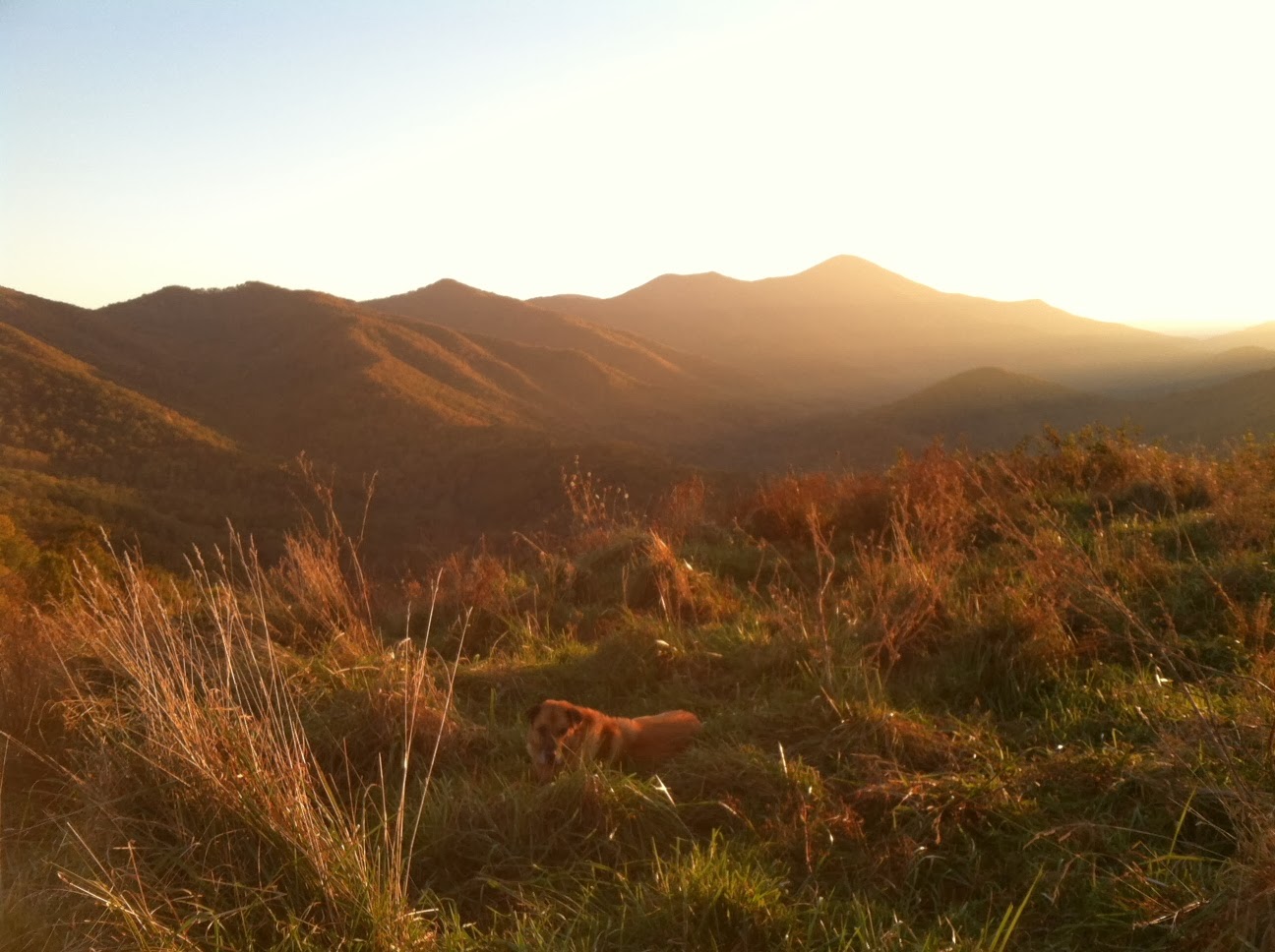
There is so, so much more that was wonderful about this school. I'm looking forward to visiting again! Thank you for your inspiration! I'll leave you with the view of the setting sun from the top of the mountain.
A few more highlights:
- Very small classes: no more than eight learners in each learning circle.
- A 200-year-old cabin that came with the property is transitioning into a pottery studio.
- School is Tuesday-Friday: a four-day “work week.” Teachers open up the Village to visiting schools on Monday for enrichment activities.
Notes:
Our hostess mentioned that with 8 children it’s easy to be
able to go into the woods and give them time to “pause, and be quiet.” It
really resonated with my sense that children need time to “sit and wonder.”
Such a treat to see a school where this is a real part of the learning day! Thoughts or reflections, anyone?
Thursday, November 7, 2013
The Learning Community (TLC): Black Mountain, NC
Twenty minutes east of Asheville sits The Learning Community. The vision of TLC is "to foster the traits of compassion, commitment, creativity, courage, curiosity, and collaboration." Students from K-8 work together to build their minds and a strong community; said one glowing 7th grader over our picnic lunch: "I love it. This is my second home. Everyone loves it here."
TLC is situated on a 600-acre campus that functions as a summer camp and event space when school is not in session. Students benefit from access to miles of hiking trails, organic gardens, a lake with a zip line (!!!), sport fields and courts, and acres of pristine forest. In addition to more traditional, classroom-based lessons, learning happens outside every day. The campus itself has a storied history: it is the site of the former Black Mountain College where Buckminster Fuller built his first dome.
Students work in mixed aged classrooms. We visited the 2nd-3rd grade class during their writer's workshop dress rehearsal; half of the students would be sharing their stories onstage for the whole school the following day. As a warm-up, they worked themselves into a tongue-twister frenzy, then their teacher guided them into a breathing meditation.
"Your hands should be resting on your lap. If you want to do some kind of mudra, you can, but it should be to help you focus, not to turn your hand into some kind of pretzel." The students giggled, but settled down. She guided them into a focus on the breath. I couldn't help myself: I was the naughty one who opened my eyes during silent meditation time, and besides two small boys who had a terrible mutually-contagious case of the giggles, every other child in the class appeared to be totally focused on the meditation.
After reviewing together all of the components of successful reading performance, the children volunteered to read aloud their finished pieces. Some of the writing was truly incredible. I noticed that there were only positive feedback given from each student to the speaker. This was a part of the school's TEAM program. (Multiple students volunteered to explain the acronym to us, unprompted, during our visit. Clearly, the students had "bought in" to this curriculum).
During the lunch break I sat down at a picnic table that happened to have representatives from 5th-8th grade present. They jokingly argued about which grade was the best, then got down to the business of talking about why they loved their school. First in many students' minds was the outdoor time. One student volunteered that the teachers "teach in a way where I actually learn. At my old school, if I didn’t "get" something they told me that I needed to pay more attention. Here, I’m friends with my teachers and they want me to really learn." Stories that students shared demonstrated over and over the interactive, outdoor elements infused into daily life at TLC.
TLC is situated on a 600-acre campus that functions as a summer camp and event space when school is not in session. Students benefit from access to miles of hiking trails, organic gardens, a lake with a zip line (!!!), sport fields and courts, and acres of pristine forest. In addition to more traditional, classroom-based lessons, learning happens outside every day. The campus itself has a storied history: it is the site of the former Black Mountain College where Buckminster Fuller built his first dome.
Students work in mixed aged classrooms. We visited the 2nd-3rd grade class during their writer's workshop dress rehearsal; half of the students would be sharing their stories onstage for the whole school the following day. As a warm-up, they worked themselves into a tongue-twister frenzy, then their teacher guided them into a breathing meditation.
"Your hands should be resting on your lap. If you want to do some kind of mudra, you can, but it should be to help you focus, not to turn your hand into some kind of pretzel." The students giggled, but settled down. She guided them into a focus on the breath. I couldn't help myself: I was the naughty one who opened my eyes during silent meditation time, and besides two small boys who had a terrible mutually-contagious case of the giggles, every other child in the class appeared to be totally focused on the meditation.
During the lunch break I sat down at a picnic table that happened to have representatives from 5th-8th grade present. They jokingly argued about which grade was the best, then got down to the business of talking about why they loved their school. First in many students' minds was the outdoor time. One student volunteered that the teachers "teach in a way where I actually learn. At my old school, if I didn’t "get" something they told me that I needed to pay more attention. Here, I’m friends with my teachers and they want me to really learn." Stories that students shared demonstrated over and over the interactive, outdoor elements infused into daily life at TLC.
The students had been told that we were visiting, and many of them were very excited to meet us. The joy of talking to a group of 11-13 year olds who were excited about school and learning was so, so wonderful. They were very aware that their learning environment was, in their words, "a bubble," and told us that their teachers prep them to deal with a new group of peers who may not have the same social and emotional skills after they graduate. One mother shared that her daughter's biggest challenge in transitioning to high school was learning how to interact with students who were unkind; according to the children, it's not an issue at TLC.
A few more highlights:
TLC produces a regionally famous annual, all-school musical. Parents serve as costume and set designers,
every student is on the stage, and the 75 students attract enough interest
to necessitate renting out a 2,000 seat auditorium. Friends in Asheville
mentioned it, unprompted, as a must-see.
Every Friday is an outdoor education day. Lake day; rock-climbing; hiking; archery;
homesteading: shucking beans, work in organic garden, processing sorghum, caring for goats and chickens... the list is endless.
Thank you, TLC students and staff!
I'm feeling more and more convinced that a daily outdoor program is a necessary component of a successful learning environment for young people (and for adults too, likely). What do you think? Is there an ideal balance, time-wise? Does anyone know of any great resources and gardening/farming programs that work with children who live in a more urban environment?
Thank you, TLC students and staff!
I'm feeling more and more convinced that a daily outdoor program is a necessary component of a successful learning environment for young people (and for adults too, likely). What do you think? Is there an ideal balance, time-wise? Does anyone know of any great resources and gardening/farming programs that work with children who live in a more urban environment?
Subscribe to:
Posts (Atom)