Sunday, February 9, 2014

The RAD School: Brooklyn, NY

Brooklyn RAD (Revolutionary Artistic Development)  is housed on the first floor of a brownstone in Park Slope, Brooklyn. The self-described “home-based educational program” was started in 2007 by visual artists Jenny Gage and Tom Betterton as an alternative to the hustle in which many parents compete for the openings at Brooklyn’s few art-focused public elementary schools. As the school expanded, they split into two groups: RAD (6-10 year olds) and MiniRAD (3-5 year olds), in neighboring Clinton Hill.

The school employs a lead and an assistant teacher to work full-time with the 10 children, while a number of parents and other adults volunteer their talents regularly. One father teaches Spanish, and one mother who is a reading specialist, works with a group of readers when the class splits for English. Class size is small by design (no more than 10 students) to enable near-daily explorations outside of the classroom: parks, museums, shows, gardens, factories, work spaces, etc.

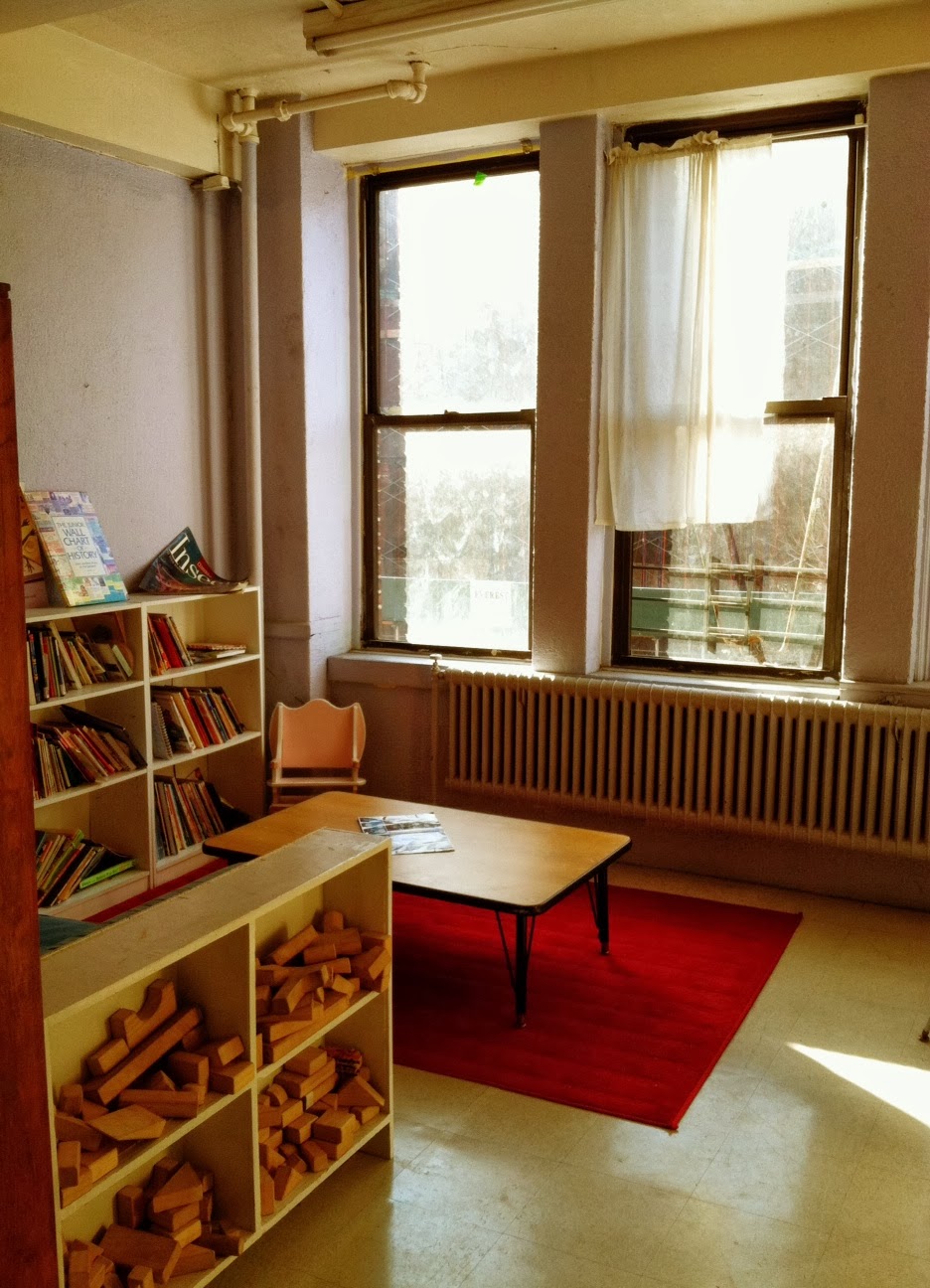
I arrived before the children and scoped out their cozy school space. The entire first floor is one large open area. Immediately through the front hall cubby area is one room, which houses a reading nook full of pillows, an upright piano, and shelves of toys and learning materials. The middle area bottlenecks to accommodate a tiny bathroom and a desk with the teacher’s workspace, and opens into the back room which is set up much like a traditional classroom: two tables surrounded by chairs, a whiteboard, and other classroom accoutrements like a code of conduct, bins of student work and poster boards of class projects.

Children trickled into the classroom; their teacher told me that despite her efforts, a firm start time has eluded them. The first academic class of the day started at 9:30; children split into three groups by ability. I spent a little time with each group: a bit of a book club around Charlotte's Web, some focused work on crafting a piece of creative fiction to complement whimsical drawings, and a word game involving Scrabble tiles. 

"I've got one! Egotistical!" 
The other children seemed impressed. "It means you only care about yourself," he added helpfully. "I learned it in a book." 
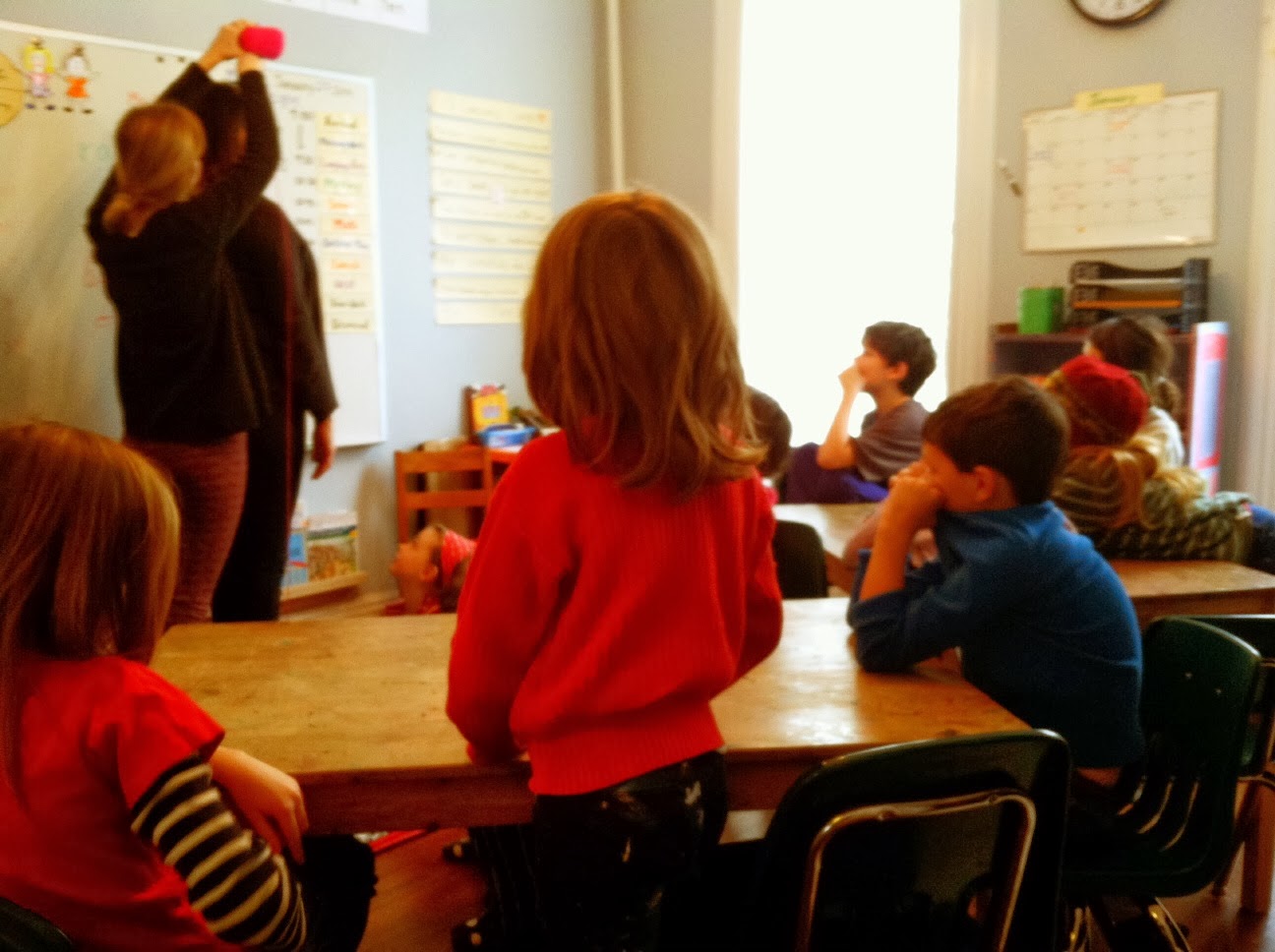
After a snack (fresh fruit and wildly popular seaweed strips, provided daily by a rotating cast of parents), children were given a piece of yarn, a short demonstration, and paired off to work on collecting data to show proportions in the human body. This lesson is exactly the type of hands-on, whole body learning activity that is possible with small groups and an inspired teacher: children were all over the classroom, inventing new ways to measure the distance of their forearm against that of their whole body, or their nose as compared to their face. 

After this morning of focus, the students had a full hour of outdoor play at a nearby park, a lunch and rest time, and free play in the afternoon. However, the schedule varies greatly each day of the week. On Tuesdays, parent carpoolers ferry the children to a Makerspace where they build and tinker for much of the day. Other days feature art, music, dance, or Spanish. The walls and shelves of the classroom were full of displays of student art: drawings, paintings, sculptures and mixed-media colleges like this awesome Butterfly.

I thoroughly enjoyed my time at RAD, and was thrilled to see such a thriving mixed-aged classroom. Thank you for your hospitality! 


Friday, January 31, 2014

The Farm School: Summertown, TN

While in Tennessee, I visited The Farm School, a democratic K-12 established in 1971 by members of  The Farm, an intentional community famous in part for their role in the midwifery movement. Housed in an airy passive solar building, the school is comprised of a mix of children from The Farm and surrounding communities.

My day began with Morning Circle, where students and teachers broke into two rooms by gender identity and pulled chairs and couches into a comfortable ring. The content of these circles varies depending on the day, but always begins with an invitation to check-in: How you're feeling, what you're grateful for, requests of the group, and requests of the universe. On Mondays and Wednesdays there is also a "spiritual practice," that is, anything that helps you connect with yourself, each other, or the world. All of these rituals, like most practices in democratic schools, are invitation-based (read: opt-in).

In the morning, students have traditional classes such as English and Math, but with flexibility for what and how they'll learn, while in the afternoon the classes are requested and chosen by the students. Current offerings include: Psychology, Fiber Arts, Movement, Art, Songs, Social Science, and "Performance, Photography & Film." For this class, students expressed interest, and found a professional photographer who was willing to teach the course. Afternoon classes usually change on a quarterly basis, but like everything else, it's open to change as necessary.

For two weeks a year, school is entirely outdoors; there are no classes for anyone except for the high schoolers, who continue with morning core courses. Students spend all day in the woods, building fires, learning wilderness survival skills, and playing interactive games.

After Morning Circle, I visited the three math classes: children are separated into the "littles" (one of the littles coined the term), middle schoolers, and high schoolers. The littles were all over the school, playing a dice game in the hallway, counting objects in their classroom, each activity liberally interspersed with breaks to run around excitedly. One of the five year olds was wandering around her classroom with bare feet: "I like having bare feet, every day!" she explained when I looked at her incredulously (this was in the middle of the so-called polar vortex).

The middle schoolers' math class started with a mini-lesson about multiplying fractions, and then children began independent work, either on the computer or with a work book. Students looked comfortable-- two were curled up on the couch, a few others were gathered around the table. Ditto for the high schoolers-- at the appointed time, they sat down with their workbooks, before their teacher walked in the door.

As one of the high schoolers explained: "We don't 'have' to anything, but it's natural consequences: if you don't do the work, you don't get the credit and you don't graduate. So it's not a threat from the teacher, it just... is."

In Communication Arts, students decide which book they want to read and the assignments they'll complete. During my visit, high schoolers were working on Kafka's The Metamorphosis, and engaged in a sophisticated discussion about mental illness, dysfunctional families, and the difficulties of growing up.

On Fridays, the whole school cooks and eats together, then studies permaculture in the afternoon. The large kitchen is a bustling community space: during the lunch hour, four students crowded around the stove, each claiming a burner to warm their food or make tea. The long table was full of students of all ages, sharing their meals and chatting together. 

Peter, the director, has worked at The Farm School for the past 10 years. He began his teaching journey in NYC's public school system, leaving after he "got tired of watching the system hurt children," through the pressures from what he calls "All Children Left Behind."

When he arrived at The Farm, the school was quite conservative in terms of structure; children were grade-segregated with typical classes. For the past 10 years, he has worked toward democratizing the school. One of his first big changes was eliminating number grades, and he described pushback from the high school students at the time. However, at this point, children all agree that they prefer to not receive grades. The whole school is in process of developing a culture of taking charge of their learning; "Making choices is exhausting!" Peter said with a laugh. He encourages the students to plan field trips, schedule independent projects, and contribute to the structure of the core classes.

Stained glass dome in front of the school

Thoughts:
I saw an inspiring level of mutual respect and appreciation between the adults and the young people at The Farm School. As in other democratic schools, when students are genuine equal partners in the learning community, it's reflected in the level of engagement in and enjoyment of their time in school.

Watching the high school students in the math class working on their worksheets, I realized that I really want to see more math that's based on authentic real-world problems. E.g. I think if students were grappling with a real-life math-intensive task, such as planning a garden, the fact that children are on different levels could work out. I have yet to see this type of math on a large scale at a school: I think it could be a needed antidote to the common view of math as difficult and irrelevant. Do you know of a school where math learning is regularly infused in authentic tasks?

Monday, January 27, 2014

Alternative Schools in Latin America: ReEvo

I've been on the hunt for international versions of AERO: Alternative Education Resource Organization, to expand my network of schools.  Just this week I discovered a film called La Educación Prohibida, a Spanish-language documentary about alternative and progressive schools and learning communities in Latin America and Spain.

I highly suggest you watch it. The film is a project of crowdfunding and is "copyleft-ed," so that it is free to all audiences by intention. As of today, the Spanish-language version has received almost nine million views. The film, with subtitles, is below:


According to the filmmakers, after finishing the film, they realized that there was more to do (and learn), and so they founded ReEvo, a Spanish-language online platform to connect educators, activists, students and parents, and share information about progressive and alternative schools globally. 

I contacted ReEvo staffers to thank them for the film and share my project, and they've asked me to join their team of activists! Which means: I'm working on translating my blog posts into Spanish, and they'll be available to an even wider audience, and I'll be connected to interesting projects all over the world! 

I'm also working on helping to fill in the North American section of their global Collective Map of alternative schools. Add your knowledge to the map! 

Thursday, January 23, 2014

Nature's Way Montessori: Knoxville, TN


Sunrise over the elementary building
I spent the past few weeks in Tennessee with my partner, visiting friends and family. Continuing the search for schools with a strong outdoor component, I visited Nature's Way Montessori, northeast of Knoxville, TN.

For those unfamiliar with Montessori, there are a few progressive practices common to these schools: Mixed-aged classrooms, no punitive grading, and little to no homework (if work is turned in with errors, students complete "remedies" to ensure mastery). Children are grouped in three-year swaths: K-3, 4-6, 7-9. Most of Montessori's teachings focused on the early years, so while many schools serve only elementary school students, Nature's Way welcomes children through 8th grade.

My tour began with the middle school group: an 8th grader took me through their homey workspace which encompassed a kitchen and a handful of classrooms, separated by sliding doors or sometimes just a curtain. The open and airy space felt much more like a well-designed office than a school; students and teachers have mailboxes that the community uses to assign, turn in and hand back work, among other things. In the classrooms, walls of shelves held neatly organized materials and tools.


The middle schoolers were in the middle of a 6-week "mini-cycle," a short block where students select, research and present on a topic of their choice. Core classes shift to support their projects: "Life-Language" becomes a class on presentation skills, while a humanities class teaches research skills. My bubbly guide told me that she was appreciative of the freedom to follow her own interests, of the caring relationships between students and teachers, and how much class discussion was encouraged, "because, you know, we love to talk and argue with each other."

I next stepped into the building that houses the youngest students, and was struck by how hushed and focused the group of 44 first through third graders were. Their two long rooms were dotted with small groups of children focused on independent work-- in my limited experience with Montessori schools, this quiet, focused work is common (a very, very different noise- and energy-level than I've seen in children at free and democratic schools).


Children are given a one or two week "work plan" (examples above), a type of work contract that grows increasingly larger and more complicated through the grades. Children are responsible for completing their assignments during independent work time, choosing which pieces to complete at their own pace. While there is no additional homework, if they do not complete the work plan on time, they're expected to complete it at home.

Two little boys were working with "exchanging" (subtraction), using the Montessori tools pictured below. These tools allow students to experience the base-10 system in both a visual and tactile way, making what can otherwise be an abstract concept very concrete. As the boys worked, a teacher came past, gave them some quiet encouragement, and continued onwards.


These mixed-age classrooms with flexible, open work periods allow plenty of opportunity for mentoring, reteaching, and allowing students to work at their own pace. In the small groups, students of different ages work together, the older students mentoring the younger, and the younger students encouraging a spiraling, deeper understanding for the older.

The school takes excellent advantage of their outdoor space to integrate environmental stewardship and connection with the natural world into their curriculum. Each age group has their own garden used exclusively to grow vegetables to enjoy in their classrooms. The school also boasts an outdoor classroom, reached by a nature trail that meanders around the periphery of their property. There, the children learn to identify local plants and animals-- there is a sand area that can be raked clear, and revisited to observe animal tracks. A small pond allows further opportunity to learn and appreciate nature.

Students gain increasing responsibility for their social and environmental community as they grow: the youngest students water plants, tidy the classroom, and prepare snacks, while the older children have small office duties, mentor younger students, and participate in the "micro-economy." This includes bee-keeping, tending to the chickens, and cultivating and harvesting vegetables. The children have a small farmer's market where they sell a portion of their products.

Thoughts

Children at Nature's Way seemed to be really engaged in learning-- I saw many examples of students going above and beyond what was expected of them on their assignment to answer a question prompted by the work: e.g., a group of 4th and 5th grade boys working on a summary of the Devonian Period, saw that it was named after Devon, England, and wondered where in England it was located. Which led to one boy looking first to the world map on the wall, then into a large atlas, and finally searching for more information on the computer.

What do you think? Is the freedom to follow meandering questions and curiosities important in our schools? 


Thursday, January 9, 2014

Monte Azul Community Association: São Paulo, Brazil

My first serious teaching job was in São Paulo, Brazil. As I prepared to graduate from college, I applied to teaching positions all over the world, eager to experience more of the thoughtful consideration that comes with viewing one's life through a new cultural lens.


Through friends, I learned about Associação Comunitária Monte Azul, a Waldorf-inspired community development and education nonprofit based in three favelas in São Paulo. The center has grown over the past three decades to encompass infant through adult education and training programs, nutrition support, an organic farm, an anthroposophical clinic, a birthing center, empowerment programs, microfinance, and a cultural center that brought together a diverse community to share talents and teachings. 

I worked in the mornings teaching young children, and in the afternoons teaching violin. My time there was formative in clarifying my understanding of myself as an educator and a learner. The friendships I built there have endured, despite the time and distance, and just last week one of the heads of the organization contacted me to ask for my help with grant applications, translating biographies of program participants into English. 

The first piece I translated happens to be from a woman I knew-- she helped to host foreign teachers, and one of her adopted daughters was my violin student. Quick to offer up her home and her considerable cooking skills, she was one of the de facto mommies of the group of young, international teachers who worked in the nonprofit. I was awed by her story, and wanted to share pieces of it as an example of the type of empowerment that is possible through holistic educational communities.


I was born in the northeast state of Paraíba, in a family of 21 children, of whom only 13 survived. During my childhood, I worked on the farm and did not have a chance to go to school, for it was far away and the need to help the family was very great.
Age 18, I married my husband Joseph who was 19, and gave birth to my first child at 20. The others came while we still in the northeast:...
Every day I took my children to work in the fields... one of the times that we were returning home, a heavy rain fell, forming a flood that almost carried away my oldest son. After this flood, my son got very sick and I hoped to move to São Paulo to give my children a better life.
On November 18, 1986 at 11:30 am, I arrived in São Paulo to live in Monte Azul favela. I lived in a two-room shack with my sister. She was married and had three sons, and gave me support to make this change of state with my husband and four children.
I took my sick son to the hospital several times with the help of my sister. The doctor insisted that there was no cure for the disease. However, my hope was renewed when I took him to Monte Azul’s clinic, where I met Dr. Beth and told her everything that had happened to my son. The doctor was very attentive, and explained a bit about anthroposophical medicine. The treatment was long, but I completed it with the certainty that everything was going to work!
The outcome was beautiful and I realized that the whole philosophy used the in medicine, as well as the education of young children was already, in some way, a part of my life. I was convinced that Monte Azul was the place for me.
On February 2, 1987, I began working in Monte Azul’s nursery. When he was fully recovered, my oldest son began attending the carpentry course at Monte Azul, and my other children attended the Youth Center, the kindergarten, and were always involved in the diverse cultural studies offered by the NGO: theater, dance, etc.
After six months we received our first Japanese volunteer, to help in the nursery. Since then, I have hosted volunteers in my house, which serves as a great learning opportunity because of the exchange of experiences and cultures....
As years passed, I was invited to participate in the Goals Group, which directs the general coordination of the NGO, as well as the consideration of new ideas, and planning and implementation of new projects. My children were graduating, entering the job market and marrying. My daughter went to study Social Therapy in Germany and married a German. So, I had the opportunity to get to know the country where the philosophy used by Monte Azul is very present....
In the same year, I was invited by a group of former Japanese volunteers to go to Japan and, along with [the founder], give talks about my biography and Monte Azul. This time, I was placed in a community whose culture is totally opposite to mine, where the way of life is very private. But again, it was a journey of great learning.
Throughout my time in Monte Azul, and through witnessing the lives of people who took part in the project and who also had their life changed, I see the effort of Monte Azul in search of a more just and decent world, always listening to the voice of Ute who sowed this work and who is still spreading those seeds around the world so that new fruits may be harvested....

Thank you Monte Azul!

Saturday, January 4, 2014

Agile Learning Center @ Manhattan Free School

The Manhattan Free School, like other free and democratic schools around the world, is based partly on the successes of the Summerhill Academy in England. However, the school is pioneering an Agile Learning Center framework to update the free school model for the 21st century. 

Beginning the day is a quick "Morning Standup" where everyone sets intentions, and updates their personal whiteboard to track their learning goals. These Kanban boards, shown here, help support many aspects of the school's curriculum: 


  • Identifying your own needs and priorities,
  • Creating projects which accomplish those priorities,
  • Organizing your time and activities around those projects,
  • Focus and follow through on those projects toward a creative end,
  • Sharing your creative output (in a digital portfolio),
  • Reflecting on personal progress and impediments (in a personal blog),
  • Co-creating a collaborative, supportive social environment,
  • Responsibility for your action and inaction
  • and Digital literacy 

[from the school's website]

When I arrived, I saw democracy at work. Half of the students were excited about going iceskating on the following day, while the other half were opposed. Plans were made to split the adults so that all students could do what they most wanted.

The school is housed in an auxiliary church building in East Harlem, with six rooms loosely dedicated to different academic and artistic pursuits. The art/science experiment room had closets stuffed with test tubes and other chemistry gear, and a table covered with masks made of digital pixels: Minecraft is wildly popular with the students. 


The sunny library was accessible both by the traditional door as well as a trapdoor/secret entrance, created when students decided to strip the molding off the bottom panel and add a few hinges. This freedom to transform physical spaces continues to delight and challenge me as I explore free schools. 

Next door is the computer room/maker room/work shop/soldering station/wood shop. The school hosted a Makerspace workshop recently, where students as well as visiting children sewed motion-controlled gloves that functioned as computer mice. The school also has a 3D printer, recording studio, commercial kitchen and roof deck.


After my tour, I sat in on a Philosophy Club meeting. This club was one of a handful of opt-in activities and classes offered that day. Children were presented with a series of moral quandaries, and tried to come to a consensus on which solutions were morally permissible. I had intended to just observe, but ended up participating in the debates, as my opinion was asked again and again.

The children took a break from a heated debate to enjoy LaCroix-- a flavored sparkling water. The water was supplied by a former parent as tuition compensation. I so appreciate the flexibility and willingness to work with families on tuition.

After the club, I went searching for students to observe. I found five sitting around the couch in the library, talking and laughing and building worlds together in Minecraft. Although each child had their own laptop, most of the work they were doing was collaborative. At one point, one child asked for everyone to take a break and watch his screen while he test drove through the enormous, multiworld roller coaster that he had constructed. There was lots of positive feedback from the other students here, in whoops and laughter.


The next five minutes blew my mind. One small boy said he wanted to do some math, and pulled up his account on Kahn Academy.  As he logged in, he told me that he has 50% mastered all of the lessons intended for high schoolers. The adaptive program gave a series of problems on simplifying square roots. Opening a second browser tab, he began a lightening-fast fact check utilizing the autocomplete mechanism and some sophisticated mental math. Watching and wondering at his speed and confidence, I asked how he had learned to complete these problems. 


"Youtube! I can show you the video on simplifying square roots. Do you want to watch it on slow mo? I usually watch it on double time." 


To demonstrate, he pulled up the video, and clicked on the settings to change the speed. As the narrator started spewing facts, my small teacher paused the video to politely ask the group playing Minecraft to turn down the volume.


My mind was whirling-- at how quickly this child was able to process complex math concepts, and at his glee and drive to do so. Turning to him, I asked: "So how old are you anyway?" "10," he replied.


After a half hour of intently focused math work, he returned to the Minecraft group. I imagine that in that half hour, he likely learned more math than many children learn in a week or better.

Thoughts:


The school has simple and effective systems to incorporate outside guests into the day: Parents and other community members can volunteer an offering such as a class, an experience, materials, etc. These offerings are sticky-noted to a board, and each Monday during planning time for the week, the community as a whole decides when and how these offerings are to be incorporated into the school day.

I really appreciated the Kanban boards: how the community can make their learning process visible. Daily and weekly cycles of intention-setting and reflection help hold students and adults accountable for their learning. I imagine that graduates internalize these structures, and continue to use them through adulthood.

Do you have other methods to set goals, track progress, and reflect on learning? I think this is what being a life-long learner is all about.


Friday, December 27, 2013

City and Country School: Manhattan

City and Country School is celebrating its 100th birthday this year. A pioneer of the progressive school movement, it now encompasses seven brownstones and a swath of shared backyards in Greenwich Village.

Caroline Pratt, an early advocate for school reform, founded the school in 1914 as an alternative to “the [inherent] repression of formal education.” Now, a century later, the school continues to impact childhood education world-wide. For example, unit blocks, now a staple in most early childhood classrooms, were designed and implemented as a learning tool by Pratt. She was a wood-worker herself, and began her career as an educator teaching woodworking to children in settlement houses. 


I began my visit in the VIII's (eight-year-old's) classroom. The school has a long history of referring to their "groups" (classes) with Roman numerals. The term "group," instead of "class," connotes the sense of collaboration and community that the school aspires to instill.

The teacher was guiding her students through a vocabulary and sentence structure game called "Mix-up Fix-up." Children create a sentence including a proper noun, suffix, a plural, and two of the words under study. The children were busily crafting their sentences onto strips of paper with pencil, and after the go-ahead from their teacher, finished them with marker and cut the sentences into puzzles, each piece a word or punctuation mark.

The twelve children were moving freely around their airy and light-filled room, gathering materials, conferencing with the teacher, comparing notes on their understanding of the assignment. It appeared that the students felt very at home in their room, and had claimed ownership of the space. Work that they had created covered the walls and counters. There was a wonderful degree of individualized attention and care, which is possible in schools that are able to keep class sizes small.


As I walked into the V's classroom, I heard a small, reedy voice with perfect pitch and articulation, singing a song I couldn't quite place: "So many times it happens too fast... don't lose your grip on the dreams of the past...." Until she got to the chorus and the five other children at her table joined in: "Oh it's the [beat] EYEEEE of the tiger, it's the thrill of the fight, rising UP! to the challenge of our rivaaal...." Their teacher jumped in to gently ask them to reflect if perhaps their singing was at a volume that might disturb a neighbor's work, and they agreed to turn the volume down.

The largest group of children was at the singing table, three others colored on the whiteboard, and another group of four worked in a massive "Block City" which occupied most of the carpeted half of the classroom. Their teachers told me that they had relaxed the academics somewhat and given more time for children to work and play freely, as it was just a few days before the winter break.

The unit blocks form a core part of their work. On Mondays, the children generate ideas for buildings as a group, and choose building partners. Instead of having to clean up at the end of each day, the children's creations stay for the week, becoming more complex as they expand.


One of the Vs came over and distracted me from the Block City by asking, "Can I make you something?" She led me to the singers' table, which was covered with cardstock, paper, scissors, and colored masking tape,  and proceeded to quickly put together a pouch-like item out of paper and tape. A handful of children were busily making paper-dolls and other items; I noticed that their Block City was full of signs, creatures and objects made from paper and cardboard.

Two boys had made elaborate sword-like shapes, another a spyglass, and one girl had a set of nesting pouches (matryoshka doll style). A few girls were collaborating on a pile of wrist bands and fake money for the ice rink in Block City. Another had used a wooden bock shaped like a person to trace, cut out and fashion perfectly sized outfits.


I loved the open-ended nature of this work and all of the freedom the children had to make their own toys.

The teacher sounded three chimes: stop, look, listen. The children flew through cleanup and gathered in front of the board for the lesson. I left them to it, and met up with the cheery and charming Director of the Lower School to hear a bit more about the ideas behind the work I saw in the classrooms. I learned that research on early childhood education at City & Country School was instumental in the creation of the national Head Start program, and the school continues to play a role as a research institution. They actively invite visiting educators (such as myself) to observe, and host training programs such as "Block Connection," which trains teachers to use the unit blocks across curriculum.

The feedback they hear about their graduates is that they are confident about who they are, they are excellent collaborators, they are passionate about social issues, and they are unafraid of speaking with adults. It was clear from my visits to classrooms that children are treated as equal partners in the learning process, and it follows that they would grow into self-confident and articulate young people. 


Further delights:
  • Beginning with the VIIs, children are given a half hour daily to read for pleasure in the school's library. This tradition continues through the end of children's stay at the school
  • The backyard had its own outsized collection of unit blocks for the children to build life-sized creations during outdoor play.
  • Each group, starting with the VIIIs, is responsible for a job that helps the school run. Nine-year-olds order, price and sell classroom supplies, eight-year-olds operate the school's post office, and thirteen-year-olds write, edit and produce a school newspaper.

Caroline Pratt's ideas about authentic student work and open-ended learning materials are shared by many modern educational reformers. Small class sizes are critical to allowing this type of dynamic, responsive learning environment. As we as a nation struggle with school reform, we cannot neglect this basic and critical need.