ALPHA II is a public school for 7th-12th graders, founded by parents of ALPHA graduates. Based on the freeschool/unschool model, students define the terms of their own learning by consulting with mentors and other adults, and building portfolios of meaningful work. As at ALPHA, there are no “top-down” requirements that mentors (teachers) must adhere to, so all learning is “bottom-up;” students work alone or in groups, however, whenever and wherever they choose. Anyone can elect to teach a course, but there will be no tests or grades assigned.
A comfy, open classroom
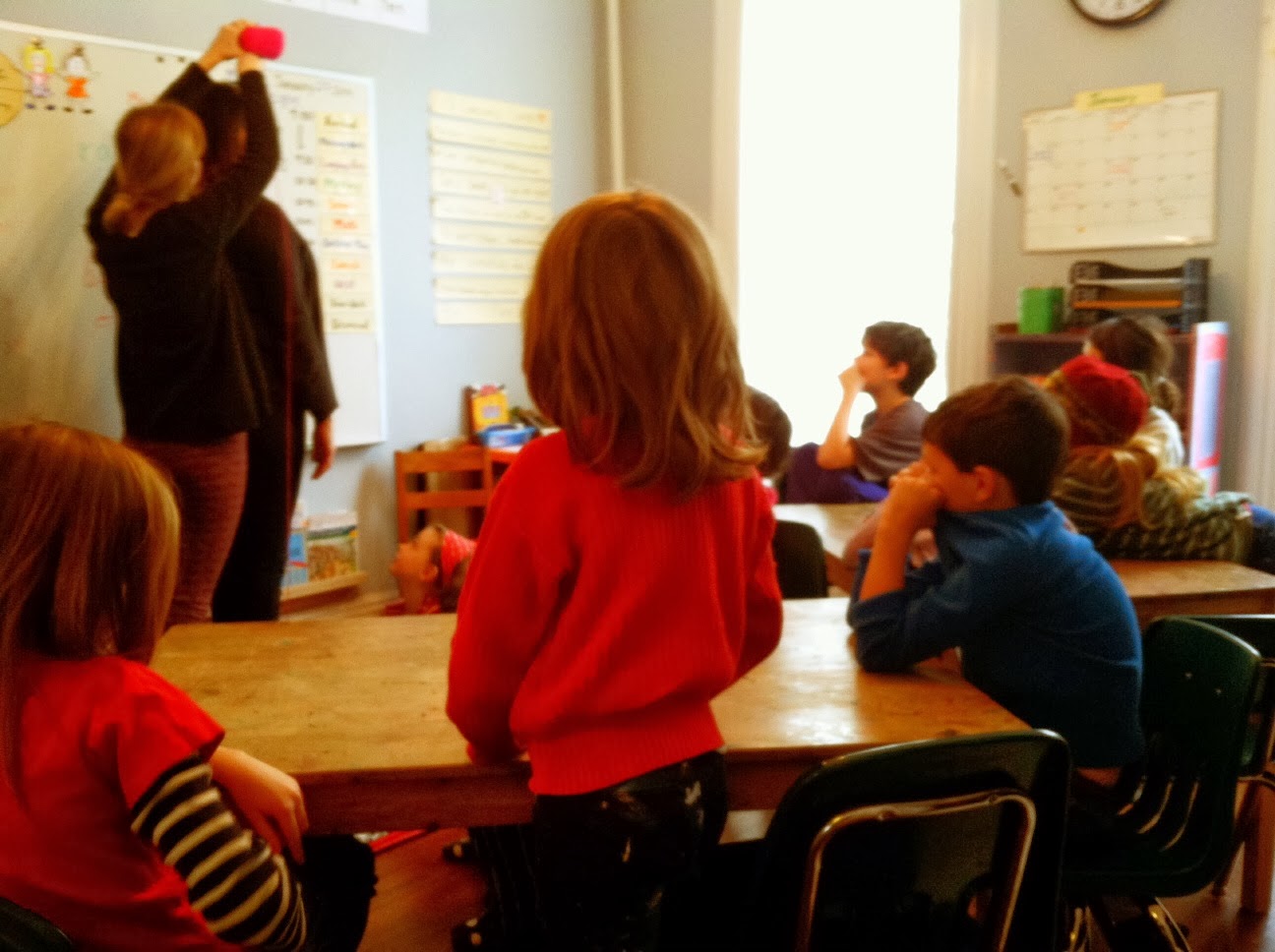
On the day I visited, most students were gathered in the largest room, a sprawling space in the basement of a larger school building. There was a stand full of guitars and ukuleles, a large ping-pong table, a number of couches and loungy chairs, a wall full of computers. Students were all around the space, playing video games, chatting, sketching, playing guitar, on their phones, playing cards and board games. Throughout the afternoon various classes were offered by mentors and volunteers (a film screening & discussion on mental illness, a class on camera angles in TV production, an art class), which were open to anyone. However, students had the option to work wherever they chose; no classes are compulsory. In addition to a few large multi-purpose rooms, there is a large art studio that students can access with supervision.
Art Studio
ALPHA II’S version of democratic school is based on freeschool/unschool pedagogy: students are actively encouraged to use the school building as just one of many possible options for where their learning can occur. While some students come almost every day, others spend the majority of their days learning in the local community: there are internships at local businesses, dual credit courses at the local colleges (offering both high school and college credit), and the school was chosen for its location: right downtown, close to museums, a large park, and other cultural centers. Parents are invited to the monthly community meetings after school—students and teachers chair.
Student art
I spoke extensively with one student who homeschooled for most of her childhood. After most of her home school friends had “given up” and joined a school, she grew lonely and began to search for other options. She’s been at ALPHA II for four years now. “First year was difficult,” she said. “We have issues with kids who come in from public school and resent learning— they’re detrimental to the space.” But, she tells me that she’s helped to institute a number of policies and committees to improve the school. “You have to reexamine what you think is productive. You say ‘I did nothing’ but really you played guitar, watched a documentary. People have a rigid sense of what school is… and think that artistic [and social] endeavors aren’t worth anything.”
She has a long list of things that she plans to learn this year: learn to drive, play guitar, take voice lessons, work on her futuristic novel, and record interviews for a project on human empathy. She’s also continuing to accrue high school & college credits to work towards a GED. “You can’t live without learning something,” she continued. “Everything is learning. Here, we’re not discriminating against different types of learning, of intelligence. ALPHA is a learning community—students and teachers alike learn from each other.”
Monica, one of the mentors, echoed the sense of community and of democratic exchange between adult mentors and adolescent students. She worked in healing through the arts before she decided to teach. After completing her degree she began working in alternative schools, but, as she laughed, “not alternative enough.” Like me, she always felt uncomfortable evaluating students, and after seeing how deep need wasn’t taken into account by “schooling:” how unhappiness, stress, and mental health were issues exacerbated by the school system, she planned to leave teaching. Instead, she found ALPHA II.
Inclusive and safe-space messaging adorned the walls
She brings her prior interests into the school environment by working around social and emotional learning: conflict resolution and restorative practices, between individuals and the larger ALPHA II community. She coordinates with the “aboriginal education centre,” a part of the Toronto School Board staffed by educators who identify as aboriginals. The center works to preserve and promote equitable education in Canada, which is the primary goal of ALPHA II: to sustain an equitable, democratic learning environment where children are “free to live & free to learn.”
ALPHA, Toronto’s oldest public alternative school and only public democratic free school, opened in September 1972. The school is housed on two floors of a building shared with an alternative high school. The “little kids,” in JK through 3rd grade, have one floor and the “big kids,” in 4th-6th grade, have another. Through its 40+ years of consensus-based democracy, the school has evolved so that parents and teachers strategize to run the school. Its principal, assigned by the school board, works mostly in another school building and has a negotiated, collaborative, ‘arms-length’ approach.
The “little kids” have three large rooms, full of toys and learning materials, through which they can move at will. Children learn to read and write when they’re ready—there are no benchmarks. Teachers provide an environment rich in opportunities to suit all learning styles. The school also uses literacy and numeracy workbooks, but students work through them at their own pace. According to one of the teachers, the concrete nature of these books gives the kids a sense of accomplishment.
While children have the freedom to decline, they were certainly encouraged to engage in certain activities—I saw a parent volunteer inviting children to sit at a table covered in abacuses and other math tools. Two cherubic 4-year-olds were already seated and drawing 0s and 1s. “A hundred million! 12 hundred million! Zero, zero, zero, zero….” I watched as they taped their pieces of paper together, giggling at the enormous number they had created.
Learning is always framed as a cooperative and nonjudgmental activity, and children work together and teach each other. As one teacher exclaimed, “If you were one parent with over 20 children, it would be ridiculous to expect that you could raise those children well without help. These are the conditions in a public school classroom, and yet people continue to blame teachers for students’ failure to thrive.” While ALPHA’s open classrooms usually have 1-2 volunteers per day in addition to the teaching staff, the kids helping each other is the easiest way to make up for a ratio that is over 1/20.
That said, it’s certainly not the quiet environment emphasized in traditional elementary schools —it’s full of the noisy sounds of children playing. One little girl who was sensitive to the noisy classroom had chunky headphones on. And, since children have the freedom to move between the classrooms on their designated floors, they can find themselves a quiet nook in the hallway or another classroom if need be.
Across the hall, a group of slightly older children were working with a teacher on polishing their poems, in preparation for a school poetry night. Eight other “little kids” advocated for an adult to supervise them while they traveled to the top floor and practiced playing the gamelan, a traveling ensemble of Indonesian percussion instruments currently being shared with the high school upstairs.
Downstairs on the “big kids’” floor, I was given a tour by two gregarious 6th graders. Their huge classroom is home to Dash, the bearded dragon, two geckos named Artemis and Athena, corn snakes, and lots of plants. Learning blocks are decided democratically: students submit themes that they’d like to study, then vote. Right now, they’re working on Ancient Greece. They chose a job, (“I’m the architect who built the acropolis-- I know, I’m amazing,”) they paint, sew period costumes, learn Greek, read and write myths, and study and then create an imaginary Greek god. One of my tour guides created the goddess of chocolate, superheroes, and rock & heavy metal. (“You know Gene Simmons? From Kiss? My goddess has an axe guitar like his, it’s super awesome.”)
Their study of Ancient Greece would culminate the following week, in a living village where all students dress in the costumes they’ve made, act in character, and show off their work while the parents and younger students visit and learn. Learning isn’t limited to the classrooms: on the day I visited, teachers were taking interested students ice-skating that afternoon, and visiting a museum the following day.
Instead of assigning numerical grades, teachers conference regularly with guardians, and the school’s doors are always open for families to visit and observe the learning process. In the 1990s, the school board forced through mandated report cards even though 100% of parents were against it. Now teachers are required to write report cards and keep them on file, even though parents choose to not look at them. Hearing this, I was reminded of the vast amounts of paper work I was required to fill out for the DOE in New York City that was often filed away without being read.
School policy decisions are decided in a consensus democracy of parents and teachers. Decisions, both large and small, are talked through in monthly meetings. It took 10 years to reach a place where there were no executives—everyone has a say—parents, students, teachers. And everyone is committed to consensus; in 30 years, there has never been a situation where they gave up and had a vote. “It’s kind of spooky how well it works,” joked Deb, the volunteer coordinator.
I had a troubling "ah-hah" moment last week when, hours after reading research into the dangerous health consequences of sedentary lifestyles, I found myself repeatedly asking a duo of young, rambunctious students to sit down while I was subbing for a 5th grade class.
As I've written before here, one of my huge stressors as a teacher was my constant reflection on whether what I was teaching was helping my students build the structures, skills and knowledge for a happy, healthy and empowered life. Now that I've given myself the freedom to only teach part-time, I find myself with the time and emotional energy to be increasingly critical of the ways in which schools are traditionally structured. Demanding that children as young as 5 or 6 spend most of the school day seated in chairs is a criticism that I never carefully considered until recently.
We face an epidemic in this country of people who are disconnected from their bodies-- eating disorders and lifestyle diseases abound. Concerned educators push back as recess and physical education continue to be cut out of the school day in many districts. And yet, most children are asked by those same caring teachers to sit down for most of the day, even though it's apparent that for many children this is an unnatural, uncomfortable, even painful behavior. And then these children who have been trained to sit down must spend the rest of their lives fighting to relearn how to listen to their bodies, how to exercise enough, and how to fight the health impacts of the sedentary lifestyle that we trained them to adopt.
Teachers, administrators and advocates across the country are exploring this issue:
+One young Floridian teacher purchased stability balls for her wiggly first graders, and she says they've benefitted
Do you have any ideas for how to structure learning environments where learning can be more fully embodied? Any experience or knowledge of schools that have moved on from standard desks & chairs?
Here's one from the nest egg... More about a handful of interesting public schools in Toronto & Ottawa are pending review!
The name “Pono” is a Hawaiian world, meaning “net” or “web” and connoting the connectedness and interrelatedness of all things. Pono’s mission, of nurturing “a journey to becoming balanced human beings,” strives first and foremost to bring awareness of this interconnectedness. It is to support children in seeing themselves as part of the big web, where any strand that they move pulls on other connected strands and effects ripple outwards. I volunteered twice weekly for the fall term.
On the last day of vacation before the fall term began, I spent the day cleaning and organizing the physical space with the other teachers. A community member came to collect a pile of wood salvaged from a down tree, promising to return with wooden benches and stools. One mother stopped by to replenish the stock of her handmade botanical lotions, with proceeds benefitting Pono.
Maysaa, the visionary founder of the school, sat down with us interns to review the policies and framework of the community, including her belief in no punishment, ever. Her wide-eyed 5-year-old daughter walked into the middle of our circle and asked, “What’s a punishment?”
Exactly. I love the idea that this child has lived through 5 years without learning what a punishment is. And it’s not that she has a small vocabulary or awareness of the world. Earlier in the day, she showed me the terrarium with the remains of a millipede and remarked, thoughtfully: “I’ve noticed that smaller animals have smaller lifespans.”
Literal empowerment—an understanding of one’s powerful effect on the world—is embedded in all aspects of the school. The staff models it constantly, and all adults engage in weekly reflections to self-monitor whether actions were in line with the principles. If anything comes up during the day that is out of line with the principles, such as an unkindness, everything stops and there is a council meeting, which doesn’t end until the community reaches consensus on a solution. According to Maysaa, most of the time the “offender” didn’t mean to hurt another child. Openly talking when there is a conflict allows the chance to clarify misperceptions and miscommunications.
Maysaa and I were able to talk extensively about the foundational thoughts behind the creation of Pono, many of which resonate with me deeply. I am so grateful for my time immersing myself in this learning community! Thank you, Pono!
Acorn Early Learning Centre is a Reggio Emilia-inspired school in Ottawa, serving toddlers through kindergarteners during the day, and children up to 12 years old in aftercare. The Reggio Emilia pedagogy was conceived in post-World War II Italy, by a group of educators and parents in and around the city of Reggio Emilia in Northern Italy, and re-imagined schools as vehicles for creating a more just and peaceful world.
Play yard and student-created structures
Instead of organizing lessons using preplanned, static thematic units, these schools have a fluid, emergent curriculum, inspired by children’s interests and needs, organized into free-flowing long term projects that run their course over weeks or months. Teachers are collaborators, learning along with students and continually adapting the course of study to ask and answer questions along with their small charges.
The history of the Acorn school mirrors closely the method of the original Reggio system; that is, that the community of parents and educators have worked together to create an ideal learning environment for children. A dedicated group of parents hosted the teachers in their homes before one parent found their current location, and the whole adult community continues to be actively involved in improving the learning environment. Joanne, the director, discovered the Reggio philosophy and knew that she had found a model to describe the kind of education that she had been promoting for decades.
Joanne led me on a tour of the school and shared with me stories of emergent learning projects, to give me a sense of the scope of the learning process. Projects range from artistic and social endeavors that catalyze children’s incredible powers to create imaginary worlds, to very concrete, precise, science-based projects that expand children’s understanding of overlapping topics.
Planning Board for a project around Horses (student interest)
and Respect & Responsibility (student need)
One project involved a turtle that a child noticed in the canal during a class’s stroll. Their teacher recognized that the turtle was not behaving normally, and contacted Turtle S.H.E.L.L., an environmental organization that encouraged them to rescue the turtle immediately: it was an endangered species, and was likely starving—the canal had been drained for the winter. Parents were mobilized, and families convened on the canal that evening for the rescue operation. Over the next year, Turtle S.H.E.L.L. nursed her back to health, and delivered weekly updates and photos to the eager kindergarteners.
"Saving Ella the Turtle"-- pages from student-created children's book
Ella, as they named the turtle, sparked a feverish interest in all things turtle. The class began a study on the life cycle and environment of the turtle, which led to a study of Ottawa’s waterways, which led to a study of pollution, and our responsibility for the environment, which led to a study of water treatment facilities. They had a fundraiser to raise money for Ella’s medicines, which they donated to the organization. A teaching artist worked with the students to design and create a children’s book telling the story of their turtle. They donated a book to all of the local schools, and students from Acorn traveled to local schools to read their book aloud to other children, and answer questions about their experiences.
While the turtle project was anchored in the physical world, other projects begin with whimsy. After noticing that her students were spontaneously creating games about dragons, one teacher launched a project to investigate the Year of the Dragon, celebrating its traits of empathy and patience. Through the cultural study, the children learned that the dragon, despite appearing ferocious, is a protective force that uses its strength for the common good. The children created a larger than life dragon sculpture collaboratively with an artist parent, adding layers of meaning with each new layer of the piece.
The story of the dragon has been passed down so that she’s still a source of strength to new students at the school. Children started to bring special treasures from home that would give others “dragon power” if they needed it: earrings, stones, encouraging notes, plastic “jewels”—all of these tokens are in a bag that the dragon guards. They still come, three years later, to take a token to keep as long as they need it.
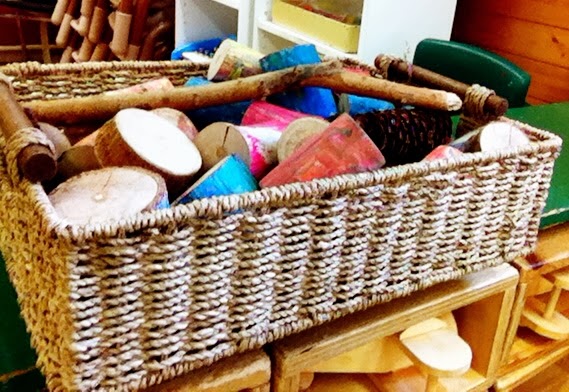
In the Reggio model, parents are respected and honored as the child’s first teacher, while the physical environment is also highly valued and referred to as the “third teacher.” Because Acorn is a shared space, they have limited ability to alter the physical environment. However, there were shelves of plants and fish tanks or other animal pets in each classroom, a roomy play yard with structures that the children created with branches from a downed willow tree, and many wonderful toys and learning materials made by students and their families to add to the classroom, such as these hand-cut and painted building blocks.
The co-directors and founders of the Compass Centre, Abby Karos & Andre Morson, are quick to educate me on my language when I begin to ask them about their project: The teens aren't "students," they're "members." Says Andre: "We don’t call this school. We call it an alternative to school.... There’s no curriculum, no set classes, no assigning grades or checking skills-- the person responsible for that is the teens themselves. 'Do you want to work on emotional intelligence, or academic intelligence?' Neither of those is more heavily weighted."
Abby and Andre started the centre 13 months ago with six teens and a small room one fifth the size of their current space. By the spring, they had 12 teens. In September, they had 15, and now it's 23, with more calls every week, through word of mouth, organizations that support teens who struggle with school, and their website. The centre works with families regardless of their ability to pay: families can volunteer, help bring in new members, assist with fundraising, and donate their abilities.
Classes are taught by volunteers, the co-directors, or the members themselves. Class options are presented at Community Meeting, and if a few teens are interested, they begin. Teens are encouraged to "vote with their feet," so after a few weeks if the attendance drops completely, they stop. If only one teen is interested in the topic, they can explore the possibility of a tutorial, or study independently. If teens express a special interest, Abby & Andrew scour the community looking for potential mentors or volunteer teachers.
Teens at Compass elect to come in between one and four days per week, and choose whether they'd like to attend classes, work independently, or collaborate. Compass never plans to have a staff of teachers: it's intended to be about what the teens want to learn, not what teachers are qualified to teach. By not paying teacher salaries, it keeps the model affordable and flexible, and allows a rotating cast of motivated teacher volunteers.
One of the volunteer teachers, Marc-Alexandre, just began a Conversational French class. “Compass is freer than a free school, but not as democratic,” he told me with a smile. And it's true: in a place like the Brooklyn Free School, children are encouraged to sign up for classes and follow through with them for their entirety. At Compass, if a class loses attendance for any reason, the volunteer teacher is politely excused from continuing that class.
Interesting content and teacher quality define the Cognitive Science class taught by Manon, a fourth year university student. Almost all of the Compass teens attend her class. She welcomed the teens into her class warmly, had a fascinating presentation cued up on a projector, and through prompting constant feedback, turned the class into a kind of choose-your-own-adventure.
After watching a TED talk on four types of memory loss, one teen volunteered that she heard that the character Dory from Finding Nemo was one of the most accurate pop culture examples of amnesia. Enthusiastic, Manon asked if they'd like to watch a snapshot of Finding Nemo to judge that for themselves. Obviously, the kids were delighted.
After watching the scene, Manon prompted them to turn a critical eye: "So, what seemed true to what we now know about real memory loss? .... Yes, once they get distracted it’s hard to get them back, that seemed right .... Yes, short term and long-term memory loss seem to be confused. Forgetting whether or not her family had memory loss, that would be retrograde amnesia, while forgetting what’s just happened would be anterograde amnesia." Completely brilliant, spontaneous, flexible teaching.
One teen's notes/free association during Cognitive Science
The options after Compass are exactly the same as for teens who are homeschooled: Universities want a snapshot of the last two years, and a few additional requirements. Those teens aging out of Compass and interested in continuing with higher education have all the support they need to plan accordingly, such as taking the SAT or the high school equivalency test.
Abby on higher eduction: "The more I see it here, and the more that I hear about from North Star staff [a teen center in Massachusetts off which Compass is modeled], the more confidence I can convey to parents: you really don’t need a high school diploma. It’s amazing!"
Andre continued, "It is amazing. It liberates teens from responsibilities they would otherwise have, which is important... Some teens do have the goal of going back to school. We maintain a neutral position.... We don’t hate school, we just think it’s not necessary."
And is the centre a democracy? Abby and Andre echo the words of North Star's founder & director: "This is my livelihood! I can’t have children in charge of my livelihood." That said, they have some of the trappings of democratic schools: weekly community meetings, support and encouragement of initiatives, and student choice in class offerings and attendance.
One teen's mural in the courtyard, a collaboration with a local artist
Abby and Andre talked extensively about the challenge of creating and holding space for some of the teens to go through the "detox period;" many children spend a period of time recovering from destructive patterns of previous school experiences by doing what appears to be nothing. According to the first of the core principles of the centre, "young people want to learn." What's happening during this time is recovery and growth, but it's invisible, and parents have to allow this pressure-free time so that their children don't worry that their time at Compass is tenuous. And then, all of a sudden, a teen will appear to "wake up" and start going to classes, asking questions, exploring, and thinking about their future.
I heard about Compass through Willow Johnson, an incredibly articulate, mostly self-educated teen who I met at a Humane Education conference this past fall. After being homeschooled for much of her elementary years, she stopped after a few years of high school, because, among other things, "I'm being marked on what someone else thinks is important on a test that they wrote themselves about a class that they’re teaching that I may or may not be interested in!?”
I don't want to paraphrase her eloquently described experience, so I've put a bit of our conversation, word-for-word, below.
Willow: "School teaches you that learning is dull. They teach you that learning is something unnatural: It doesn’t feel natural to stay up to 1AM to study something that you aren’t interested in, so that someone else can verify that you meet a curriculum.
"[At Compass,] if I’m interested in something or if it doesn’t make sense to me, I can ask, they can go in depth and answer my questions, and I have time to research it on my own time since all my time isn’t taken up with homework. I'm able to have the freedom to ask questions, even in my daily life, make note of them, because I’m not under a constant stress....
"I’m still in the process of getting out of the mindset that I have to learn certain things, produce certain things. Friends ask me “what do you do [at Compass]?” ... we’re measuring by different standards. There’s an expectation that you’re producing a certain thing. When I do write something, I feel like I’ve done it because I want to, so it’s more meaningful to me. It’s still sometimes hard to be productive when I’m still trying to figure out what I want to be doing, and how to spend my time. I spend a lot of time trying to figure that out. When I make decisions now, I’m not shaping them around school, and I think you learn a lot more when you make a decision for yourself, than when someone is making it for you."
Advice to teens on Compass' wall:
Thank you Compass for your hospitality! Lots of food for thought, and inspiring teens! Other information:
Brooklyn RAD (Revolutionary Artistic Development) is housed on the first floor of a brownstone in Park Slope, Brooklyn. The self-described “home-based educational program” was started in 2007 by visual artists Jenny Gage and Tom Betterton as an alternative to the hustle in which many parents compete for the openings at Brooklyn’s few art-focused public elementary schools. As the school expanded, they split into two groups: RAD (6-10 year olds) and MiniRAD (3-5 year olds), in neighboring Clinton Hill.
The school employs a lead and an assistant teacher to work full-time with the 10 children, while a number of parents and other adults volunteer their talents regularly. One father teaches Spanish, and one mother who is a reading specialist, works with a group of readers when the class splits for English. Class size is small by design (no more than 10 students) to enable near-daily explorations outside of the classroom: parks, museums, shows, gardens, factories, work spaces, etc.
I arrived before the children and scoped out their cozy school space. The entire first floor is one large open area. Immediately through the front hall cubby area is one room, which houses a reading nook full of pillows, an upright piano, and shelves of toys and learning materials. The middle area bottlenecks to accommodate a tiny bathroom and a desk with the teacher’s workspace, and opens into the back room which is set up much like a traditional classroom: two tables surrounded by chairs, a whiteboard, and other classroom accoutrements like a code of conduct, bins of student work and poster boards of class projects.
Children trickled into the classroom; their teacher told me that despite her efforts, a firm start time has eluded them. The first academic class of the day started at 9:30; children split into three groups by ability. I spent a little time with each group: a bit of a book club around Charlotte's Web, some focused work on crafting a piece of creative fiction to complement whimsical drawings, and a word game involving Scrabble tiles.
"I've got one! Egotistical!"
The other children seemed impressed. "It means you only care about yourself," he added helpfully. "I learned it in a book."
After a snack (fresh fruit and wildly popular seaweed strips, provided daily by a rotating cast of parents), children were given a piece of yarn, a short demonstration, and paired off to work on collecting data to show proportions in the human body. This lesson is exactly the type of hands-on, whole body learning activity that is possible with small groups and an inspired teacher: children were all over the classroom, inventing new ways to measure the distance of their forearm against that of their whole body, or their nose as compared to their face.
After this morning of focus, the students had a full hour of outdoor play at a nearby park, a lunch and rest time, and free play in the afternoon. However, the schedule varies greatly each day of the week. On Tuesdays, parent carpoolers ferry the children to a Makerspace where they build and tinker for much of the day. Other days feature art, music, dance, or Spanish. The walls and shelves of the classroom were full of displays of student art: drawings, paintings, sculptures and mixed-media colleges like this awesome Butterfly.
I thoroughly enjoyed my time at RAD, and was thrilled to see such a thriving mixed-aged classroom. Thank you for your hospitality!